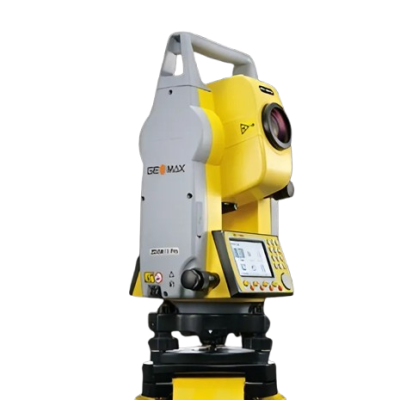
A Total Station is an advanced surveying instrument used in the fields of construction, engineering, and mapping. It combines an electronic theodolite (for measuring angles), an electronic distance measurement (EDM) device, and a microprocessor for data storage and processing. Total stations are widely used for tasks like land surveying, topographic mapping, and construction layout.
1. Surveying : For boundary measurements, topographic surveys, and construction staking. 2. Mapping : Generating precise maps or plans for infrastructure projects. 3. Building Layouts : Marking out construction sites and ensuring the correct placement of structures. 4. Geodesy : Conducting high-precision measurements over large areas.
Angle measurement
It measures horizontal and vertical angles precisely using an electronic theodolite.
Distance measurement
It calculates distances using the EDM feature, often based on the time it takes for a light signal (usually infrared) to travel to a target and back.
Data storage and processing
The onboard computer can store measurement data, calculate coordinates, and even assist with mapping or generating reports.
Coordinate calculation
Using the measured angles and distances, the total station can determine the coordinates of points in 2D or 3D space.
Let’s Talk About How Can Help You Securely Advance